
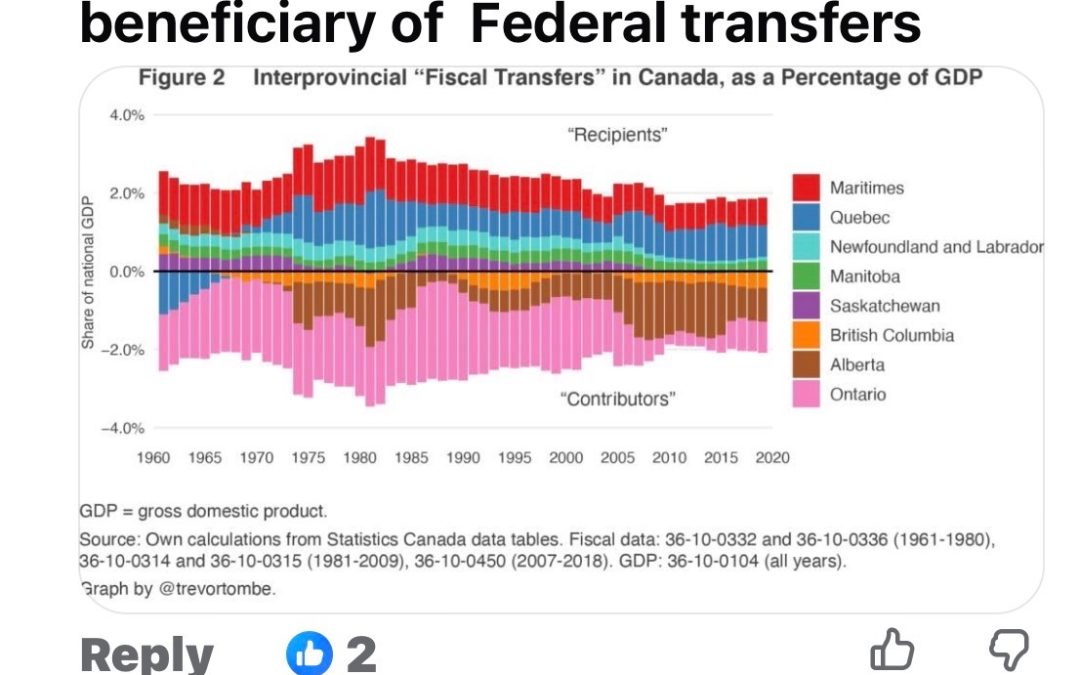
Over the past 50+ years, federal transfers have played a central role in shaping fiscal relationships among Canadian provinces. These transfers — primarily Equalization, the Canada Health Transfer (CHT), the Canada Social Transfer (CST), and various targeted programs — are designed to ensure reasonably comparable public services across the country while maintaining national standards in healthcare, education, and social assistance. The distribution of these transfers has shifted over time, reflecting economic cycles, demographic change, and the evolving fiscal capacity of provinces. Saskatchewan’s position within this system has been particularly dynamic.
The Structure of Federal Transfers
Canada’s transfer system rests on two broad pillars:
- Equalization, established in 1957 and constitutionally entrenched in 1982, which compensates provinces whose fiscal capacity falls below a national standard.
- Major per-capita transfers, particularly the CHT and CST, which are distributed on an equal per-person basis regardless of a province’s wealth.
Equalization is funded from general federal revenues and does not involve direct provincial contributions. Instead, wealthier provinces tend to contribute more in federal taxes overall, while provinces with lower fiscal capacity receive payments.
Major Beneficiaries Over Five Decades
Over the last half century, the principal long-term recipients of Equalization have been:
- Quebec
- Manitoba
- Nova Scotia
- New Brunswick
- Prince Edward Island
- Newfoundland and Labrador (until offshore resource growth reduced eligibility)
Quebec has consistently been the largest total recipient due to its population size, though its per-capita payments have often been lower than those of smaller Atlantic provinces. The Atlantic provinces have historically relied heavily on Equalization due to smaller tax bases, aging populations, and more limited industrial diversification.
Manitoba has also been a steady recipient, reflecting a mid-sized economy with moderate fiscal capacity but lower per-capita revenue potential compared to the national average.
Ontario, long considered Canada’s economic engine, was historically not a recipient. However, following the 2008 global financial crisis and manufacturing sector decline, Ontario received Equalization from 2009 to 2018 — a significant shift that highlighted how economic downturns can alter provincial status within the federation.
Alberta and British Columbia have rarely received Equalization over the past 50 years. Alberta, in particular, has consistently had the highest fiscal capacity due to oil and gas revenues, making it the most prominent “net contributor” province in fiscal balance discussions.
Evolution and Economic Cycles
Resource booms and busts have strongly influenced transfer patterns. During energy booms in the 1970s, early 2000s, and mid-2010s, oil-producing provinces experienced surges in fiscal capacity. During downturns, their revenue capacity declined sharply.
Meanwhile, demographic changes — particularly aging populations in Atlantic Canada — increased healthcare costs and reduced labour force growth, reinforcing reliance on federal transfers.
The structure of Equalization has also evolved. Reforms in 1982, 1999, and 2007 adjusted formulas to account for resource revenues and to cap or stabilize payments. The 2007 reforms, for example, introduced a ten-province standard and a fiscal capacity cap to address concerns about fairness.
Saskatchewan’s Shifting Position
Saskatchewan’s experience over the past 50 years illustrates how fluid provincial beneficiary status can be.
In the 1970s and 1980s, Saskatchewan was frequently an Equalization recipient. Its economy was heavily dependent on agriculture and faced fiscal pressures from commodity volatility and drought cycles. The province’s fiscal capacity often fell below the national average.
However, the early 2000s marked a turning point. A surge in oil production, potash prices, and uranium demand significantly boosted provincial revenues. By 2008, Saskatchewan no longer qualified for Equalization and, in several years, became one of the provinces with above-average fiscal capacity.
Since then, Saskatchewan has generally not received Equalization payments, although it continues to receive CHT and CST funding on a per-capita basis, along with substantial federal expenditures such as agricultural support, Indigenous services funding, infrastructure spending, and direct transfers to individuals (Old Age Security, Canada Pension Plan, Employment Insurance).
The province’s role in national debates has increasingly mirrored that of Alberta: concerns about how resource revenues are treated in Equalization calculations and whether energy-producing provinces contribute disproportionately to federal redistribution.
Broader Fiscal Balance Context
It is important to distinguish between Equalization receipts and total federal spending in a province. Even provinces that do not receive Equalization still receive billions annually through healthcare transfers, social transfers, and federal program spending. Likewise, provinces that receive Equalization also contribute federal tax revenue through their residents and businesses.
Over the long term, the largest cumulative beneficiaries of Equalization have been Quebec and the Atlantic provinces. Ontario’s temporary recipient status underscores how economic restructuring can alter fiscal standings. Western provinces — particularly Alberta and, more recently, Saskatchewan — have often been net contributors during resource booms but remain subject to economic cycles.
Conclusion
Over the past five decades, federal transfers have functioned as a stabilizing mechanism within Canada’s federation. The primary beneficiaries have been Quebec, Manitoba, and the Atlantic provinces, with Ontario briefly joining that group during economic downturn. Saskatchewan’s journey from recipient to non-recipient highlights how provincial status can shift with commodity markets and economic growth.
Rather than representing permanent divisions between “payer” and “receiver” provinces, the history of federal transfers reveals a system designed to adapt to changing economic realities — one in which Saskatchewan has occupied both sides of the equation over time.n fiscal capacity, not actual payments to Ottawa, and that federal programs operate nationally for the benefit of all Canadians regardless of province.