
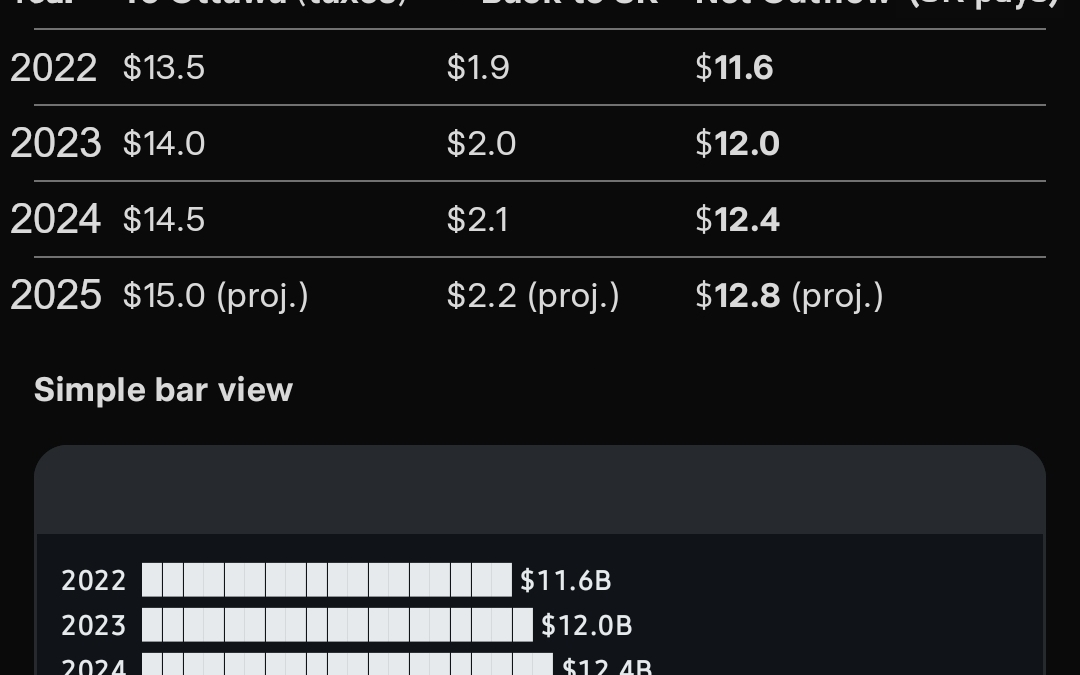
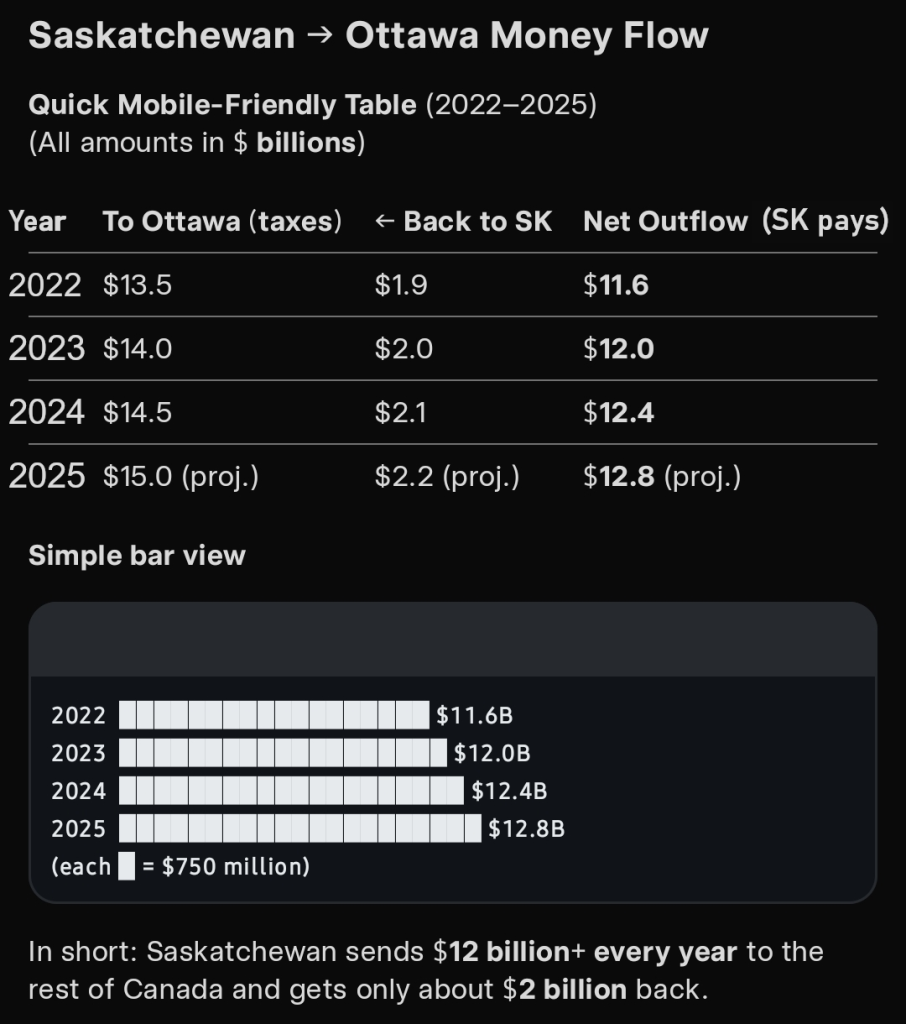
In short, Saskatchewan sends around $12 billion to the rest of Canada every year and gets only about $2 billion back.
The claim that Saskatchewan sends roughly $12 billion to the rest of Canada each year while receiving about $2 billion back usually refers to discussions about federal taxation, equalization, and fiscal transfers within Canada’s federation. To understand this issue clearly, it is important to distinguish between different types of financial flows: federal taxes collected in Saskatchewan, federal spending within the province, and equalization payments between provinces.
Saskatchewan is a resource-rich province with significant oil, natural gas, potash, uranium, and agricultural production. In strong commodity years, these industries generate substantial corporate profits, personal incomes, and royalties. As a result, residents and businesses in Saskatchewan pay federal income taxes, corporate taxes, and other federal levies. When commentators state that Saskatchewan “sends $12 billion” to Ottawa, they are typically referring to the total amount of federal revenue collected from individuals and businesses located in the province in a given year.
The second part of the claim — that Saskatchewan “gets back about $2 billion” — usually refers to certain direct federal transfers or equalization payments. However, this figure can be misleading if interpreted too narrowly. Saskatchewan does not currently receive equalization payments in most years because equalization is designed to assist provinces with below-average fiscal capacity. Equalization is funded from general federal revenues and redistributed to provinces whose ability to raise revenue is below the national standard. Provinces such as Quebec and several Atlantic provinces are the primary recipients.
That said, equalization is only one component of federal spending. Saskatchewan also receives substantial federal funding through programs such as the Canada Health Transfer (CHT), the Canada Social Transfer (CST), infrastructure funding, agricultural support programs, Indigenous services, employment insurance benefits, Old Age Security, Canada Pension Plan payments, and federal public sector wages. When all federal expenditures in Saskatchewan are totaled — including benefits paid directly to individuals — the amount returned to the province is significantly higher than $2 billion.
The broader debate often centers on net fiscal balance, which compares total federal revenues collected in a province with total federal spending in that province. In years when Saskatchewan’s resource sector performs strongly, the province can be a “net contributor,” meaning more federal revenue is collected there than is spent locally. In weaker resource years, that balance can shift. These fluctuations reflect commodity cycles rather than permanent structural imbalances.
Supporters of the view that Saskatchewan is treated unfairly argue that the equalization formula does not adequately account for the volatility of resource revenues and that provinces rich in natural resources are effectively penalized for developing them. Critics of that perspective counter that equalization is based on fiscal capacity, not actual payments to Ottawa, and that federal programs operate nationally for the benefit of all Canadians regardless of province.